
AL-RASHEED SMART UNIVERSITY | FACULTY OF ENGINEERING & IT
Department of Cybersecurity
DroidX: An On-Device Intelligent Android Risk Scoring & Malware Detection Application
Based on Permission Chaining and TinyML
Prepared By (Student Team):
Talal Khalid Omar202310100127
Abdulrahman Ameen AL-Sattani202310100190
Supervised By:
Prof. Jamel SaadAcademic Supervisor
Eng. Ahmed MotaharAssistant Supervisor
Background & Context
Slide 02 / 19- Targeting Android 10.0+ (API Level 29+).
- Linux UID sandbox process isolation.
- Manual user approval for hardware/data access.
- Signature matching (e.g., SHA-256 hashes).
- Cloud telemetry inspection & remote analysis hubs.
- Google Play Protect & commercial MTD tools.
Problem Statement
Slide 03 / 19Commercial tools transmit app inventories, usage patterns, and device IDs to cloud servers, causing privacy and surveillance risks.
Standard deep neural networks cause thermal throttling, RAM saturation, and rapid battery exhaustion when executed locally.
Traditional static scanners evaluate permissions in isolation, failing to detect dangerous multi-permission combinations.
Security tools output raw probability scores or CVE tags, leaving non-technical users unable to interpret risks.
Objectives & Aims
Slide 04 / 19- 100% Offline Inspection Engine (zero network telemetry).
- Optimized Quantized TinyML Classifier (Compact footprint).
- Comprehensive Feature Matrix from CICMalDroid2020.
- Deterministic Permission-Chaining Heuristics.
- Explainable AI (XAI) Plain-Language Guidance.
- Google Play Integrity API & Local Diagnostics.
- High Detection Accuracy and reliability standards.
- Fast on-demand scan latency in seconds.
- Minimal RAM footprint with negligible background resource drain.
Scope & Limitations
Slide 05 / 19- Target Platform: Modern Native Android OS.
- Target Audience: Everyday users and enterprise personnel.
- Inspection Scope: Manifest analysis (permissions, intent filters, hardware tags).
- Execution Mode: On-demand local scans without background polling.
- Static Analysis Limit: Cannot inspect runtime code loading (DCL) or reflection.
- Repackaged App Blind Spot: Modified packages preserving benign manifests display lower static risk.
- Dataset Vocabulary: Neural weights operate over a structured feature schema.
Constraints Matrix
Slide 06 / 19- RAM Footprint: Strictly optimized and bounded volatile memory usage during scans.
- Storage Size: Highly compact model binary and lightweight application package.
- CPU/Battery: Zero idle background daemon usage; no noticeable battery drain.
- Zero Network Access: Complete omission of internet connectivity permissions.
- Non-Root Execution: Strictly bounded within standard Linux UID sandbox.
- Fallback Diagnostics: Graceful local fallback if cloud or remote verification is unreachable.
Literature Review & Benchmarking
Slide 07 / 19| System | Technology Used | Key Advantages | Limitations |
|---|---|---|---|
| DREBIN | Static Analysis + Linear SVM | Fast static classification, low overhead | Legacy ML, vulnerable to obfuscation, No XAI |
| Alfaw et al. | TFLite, Deep Learning models | High classification accuracy, local execution | Higher memory allocation, No XAI, no remediation |
| Hypatia | ClamAV Signatures (Hashes) | 100% offline, zero battery drain | Signature-based; blind to zero-day malware |
| DroidX (Proposed) | INT8 TFLite MLP + XAI + Rules | 100% offline, TinyML, XAI, Chaining | Bound by static analysis manifest scope |
Methodology & Workflow
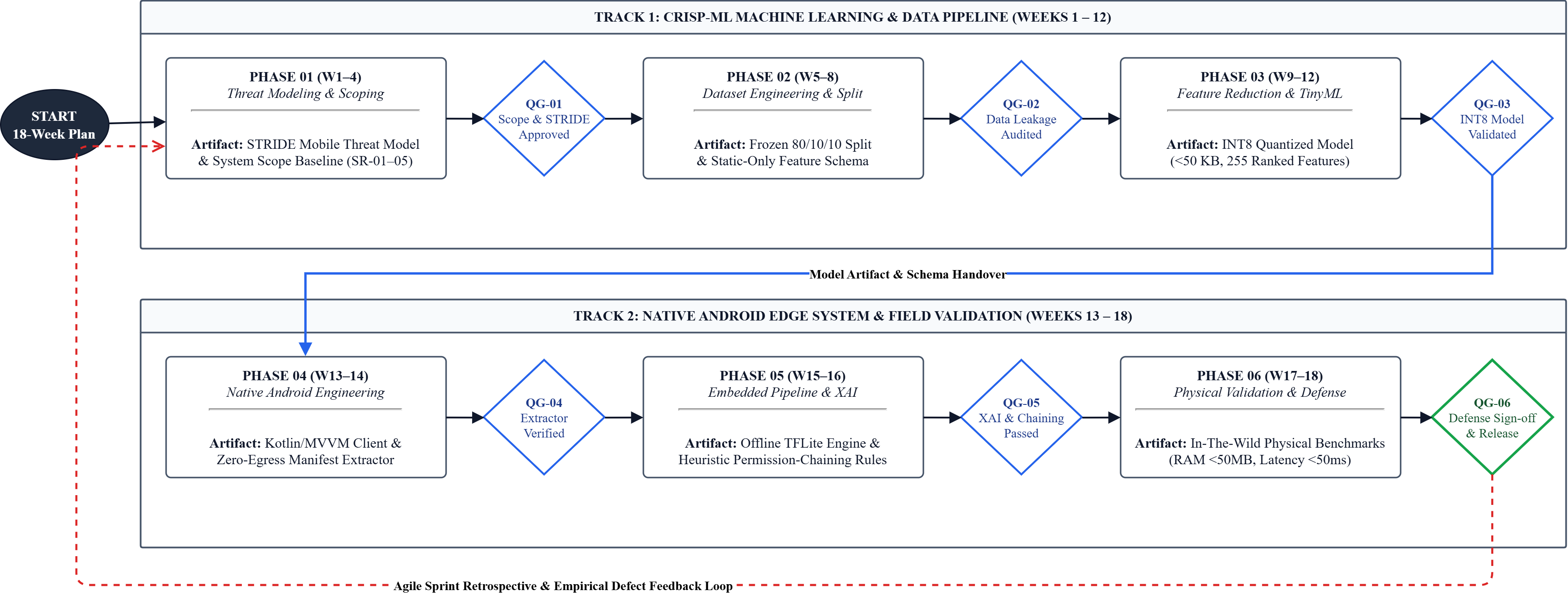
Slide 08 / 19- Track 1: CRISP-ML Machine Learning & Data Pipeline.
- Track 2: Native Android Edge System & Field Validation.
- Agile Sprints: Critical path tracking & milestone sign-offs.
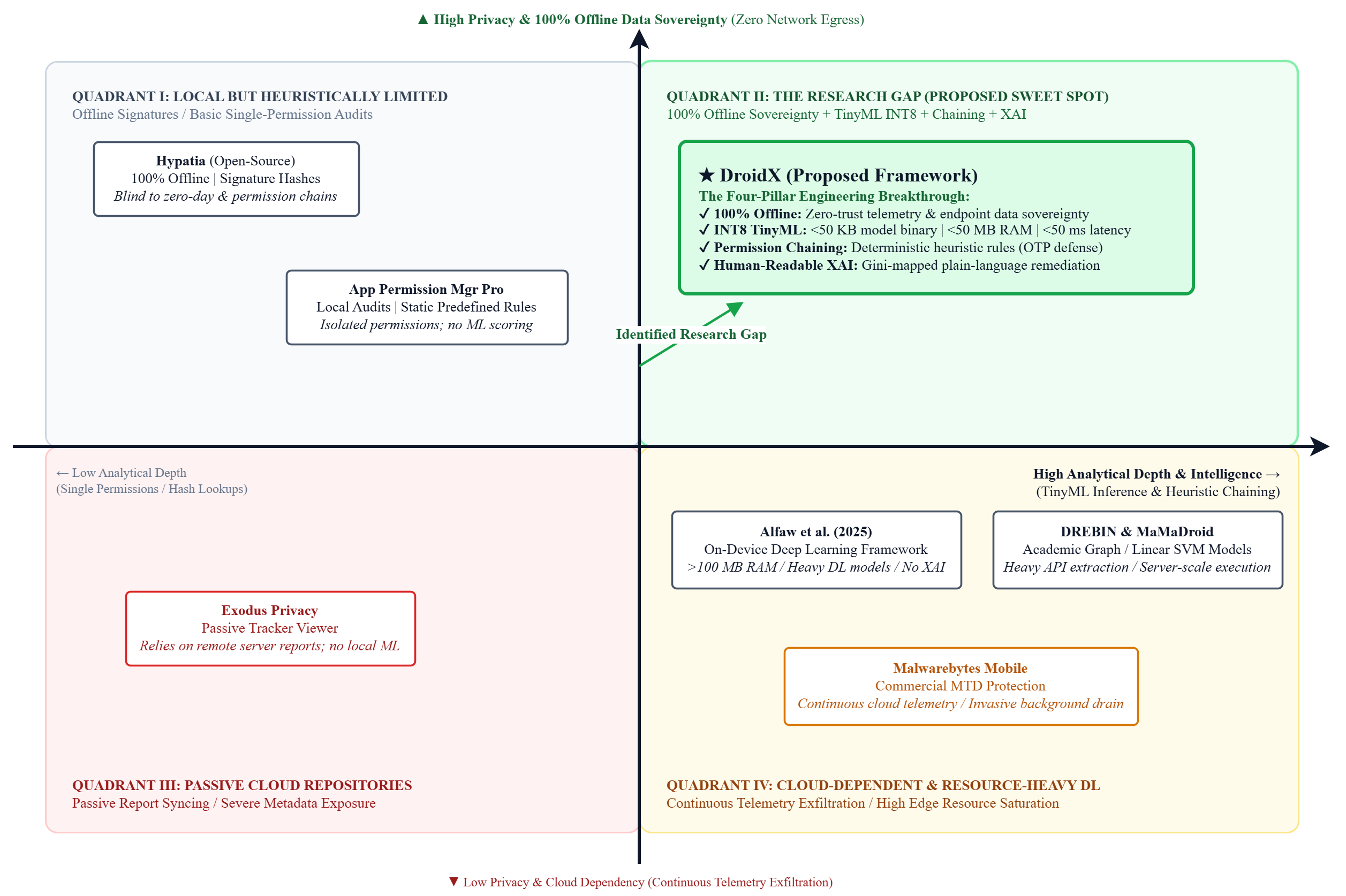
Research Gap (Quadrant II)
Slide 09 / 19100% Offline, zero telemetry exfiltration.
Optimized TinyML with minimal execution latency.
Deterministic heuristics for multi-permissions.
Plain-language threat remediation mapping.
System Requirements
Slide 10 / 19- FR-01: Static package enumeration via PackageManager.
- FR-02: Structured feature vector transformation.
- FR-03: On-device TinyML model inference.
- FR-04: Deterministic permission-chaining heuristics.
- FR-05: Explainable AI (XAI) plain-language mapping.
- NFR-01: Fast inference & rapid complete audit.
- NFR-02: Bounded volatile memory footprint.
- NFR-03: Lightweight storage for binaries.
- NFR-04: High validation accuracy metrics.
- NFR-05: Zero idle CPU & battery impact.
System Architecture
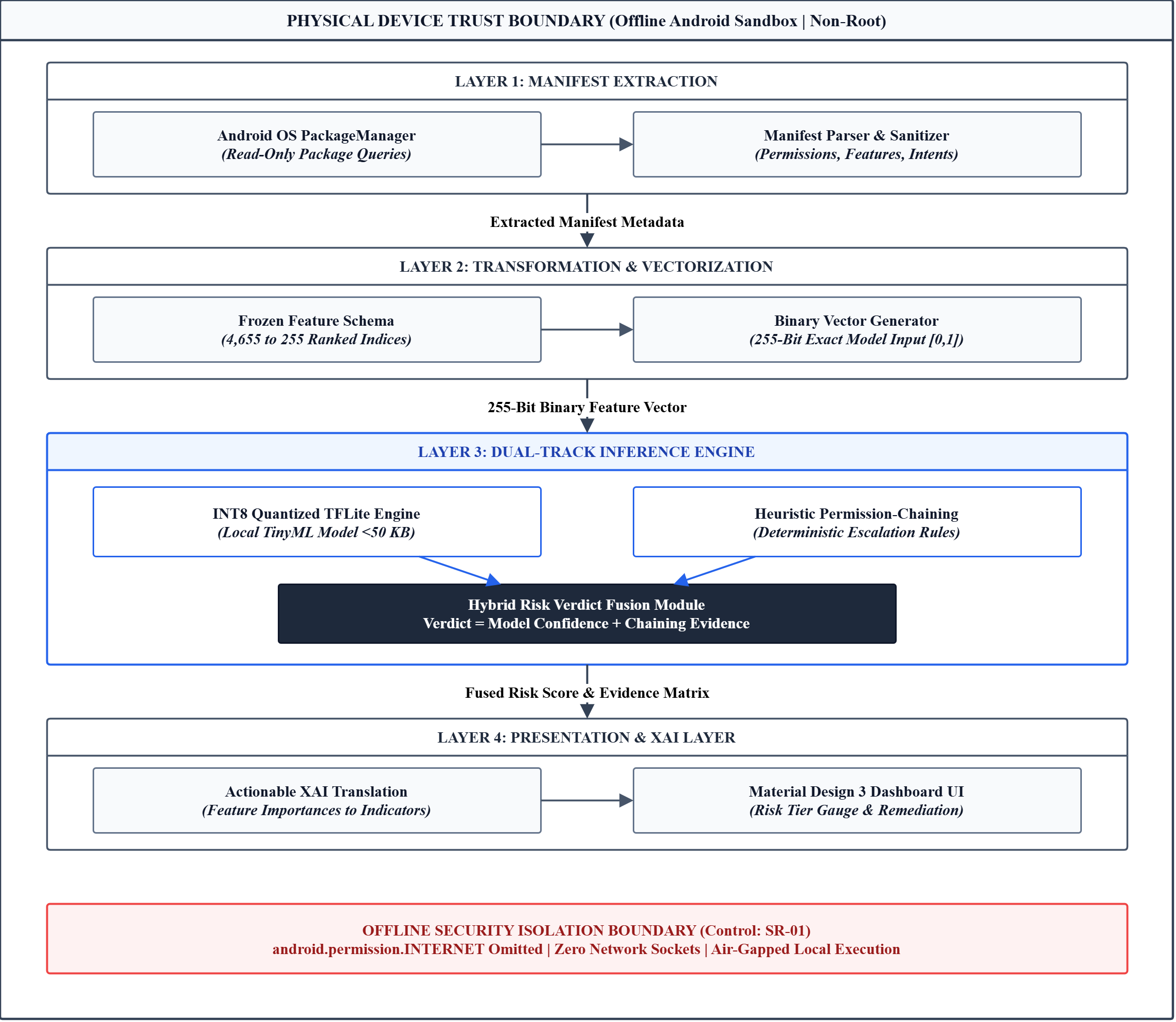
Slide 11 / 19- Extraction Layer: Native PackageManager queries.
- Transformation Layer: Feature vector generator.
- Dual Inference: TinyML + Heuristics.
- Presentation Layer: Material Design 3 XAI.
Use Case & Misuse Case Modeling
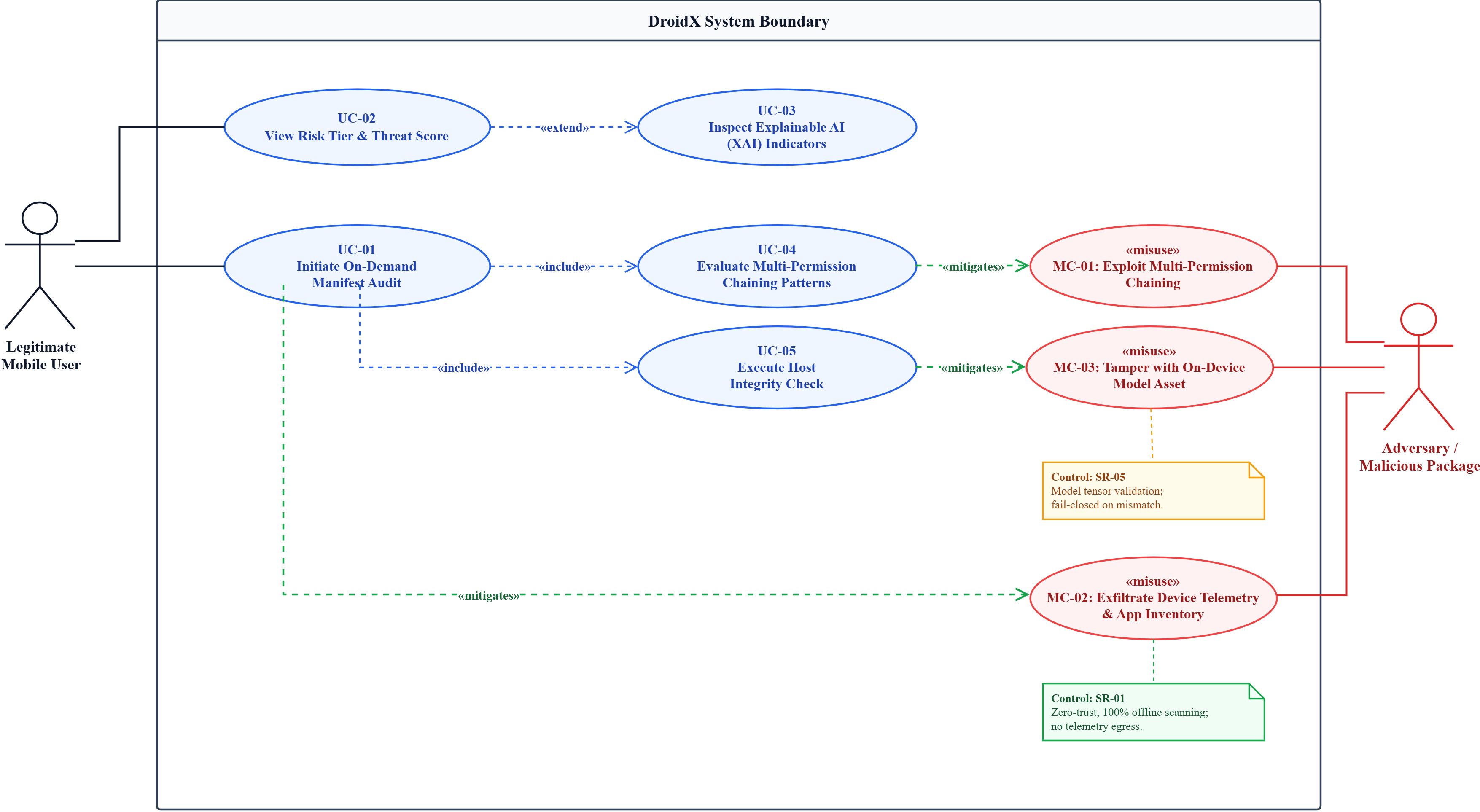
Slide 12 / 19- UC-01: Initiate On-Demand Audit.
- UC-04: Evaluate Multi-Permission Chains.
- MC-01: Exploit Chaining (Intercepted).
- MC-02: Telemetry Exfiltration (Mitigated by offline air-gap).
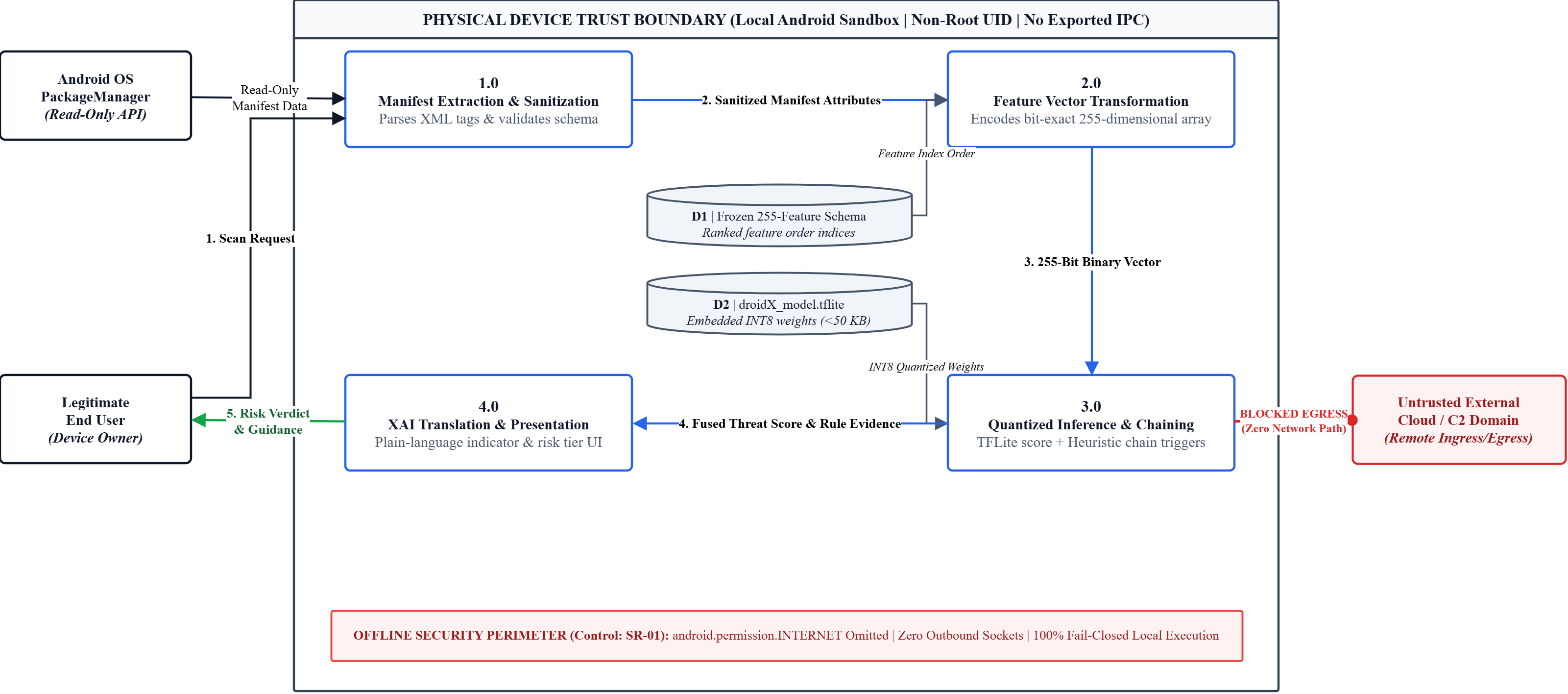
Data Flow Diagram (DFD Level 1)
Slide 13 / 19- Process 1.0: Manifest Extraction & Sanitization.
- Process 2.0: Vector Transformation.
- Process 3.0: TinyML Inference & Chaining.
- Egress Control: External cloud connection strictly blocked.
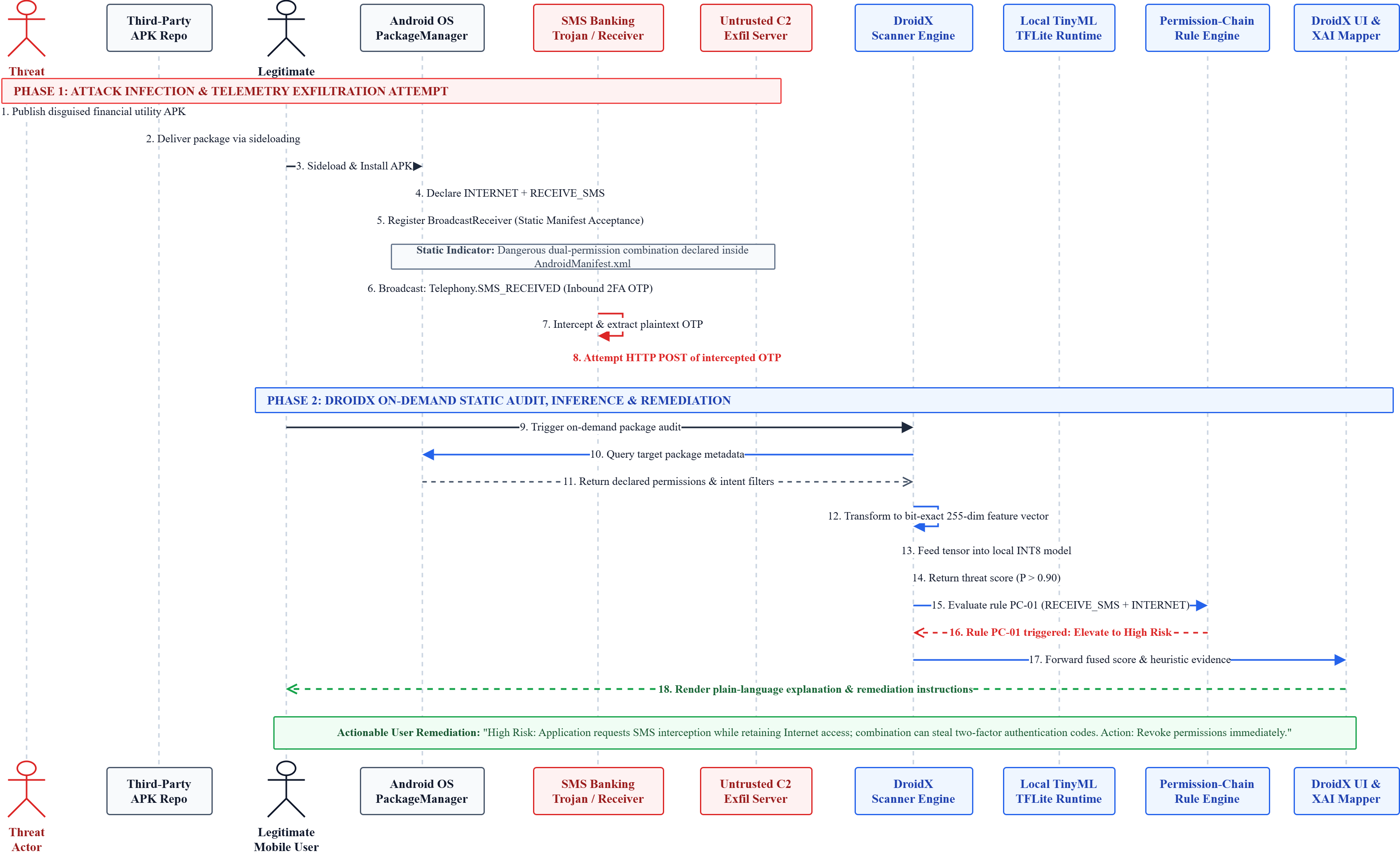
Scenario 1: SMS Banking Trojan
Slide 14 / 19- Attack Vector: Trojan paired with `RECEIVE_SMS` + `INTERNET`.
- TinyML Score: Neural network flags high threat probability.
- Chaining Trigger: Rule PC-01 forces High-Risk verdict.
- XAI Remediation: Warns user of 2FA OTP theft risk.
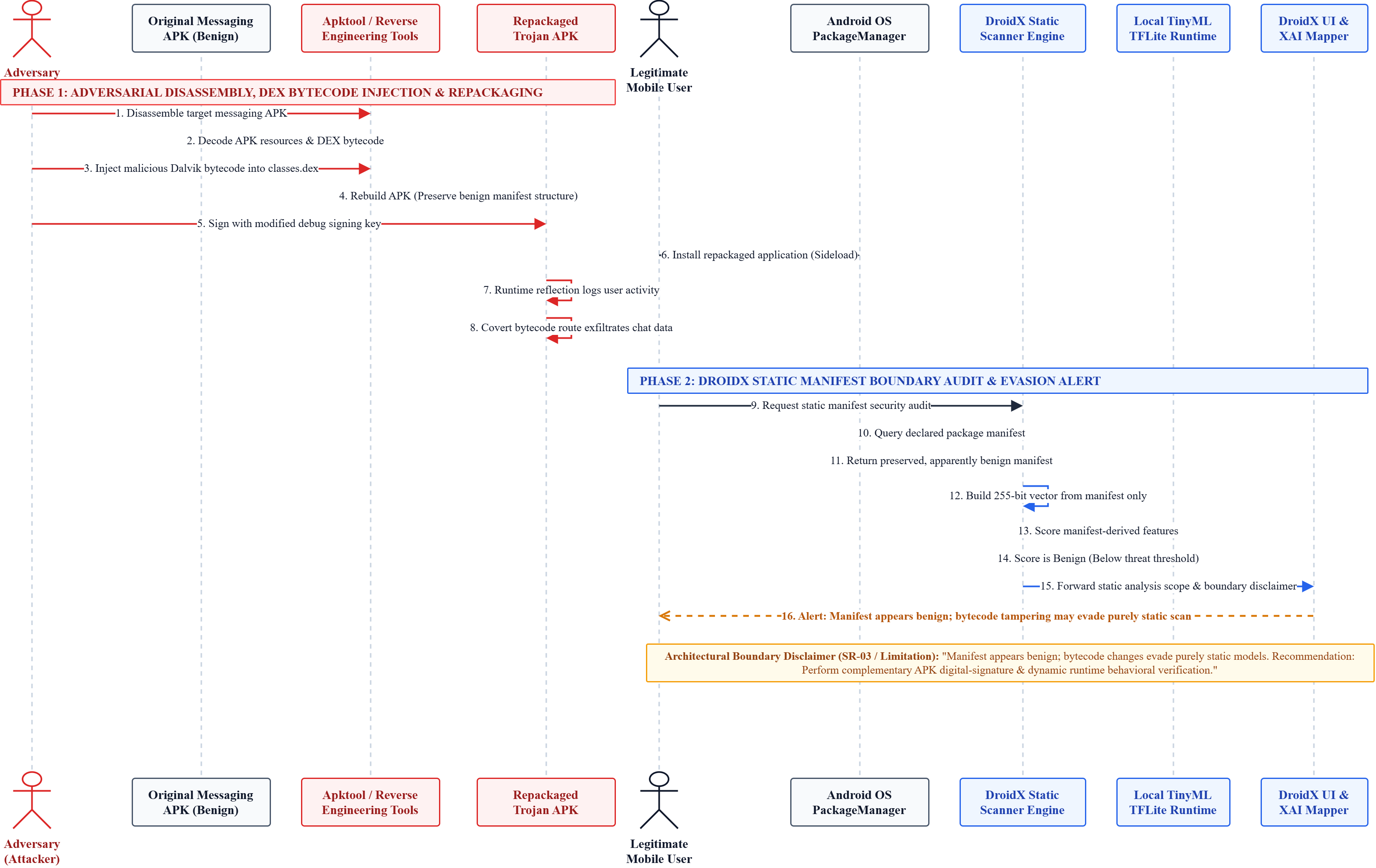
Scenario 2: Repackaged Application Evasion
Slide 15 / 19- Adversarial Path: Disassembles APK, injects bytecode, preserves manifest.
- Static Limit: Structural audit yields baseline score.
- XAI Boundary Alert: Discloses limit and recommends signature/dynamic verification.
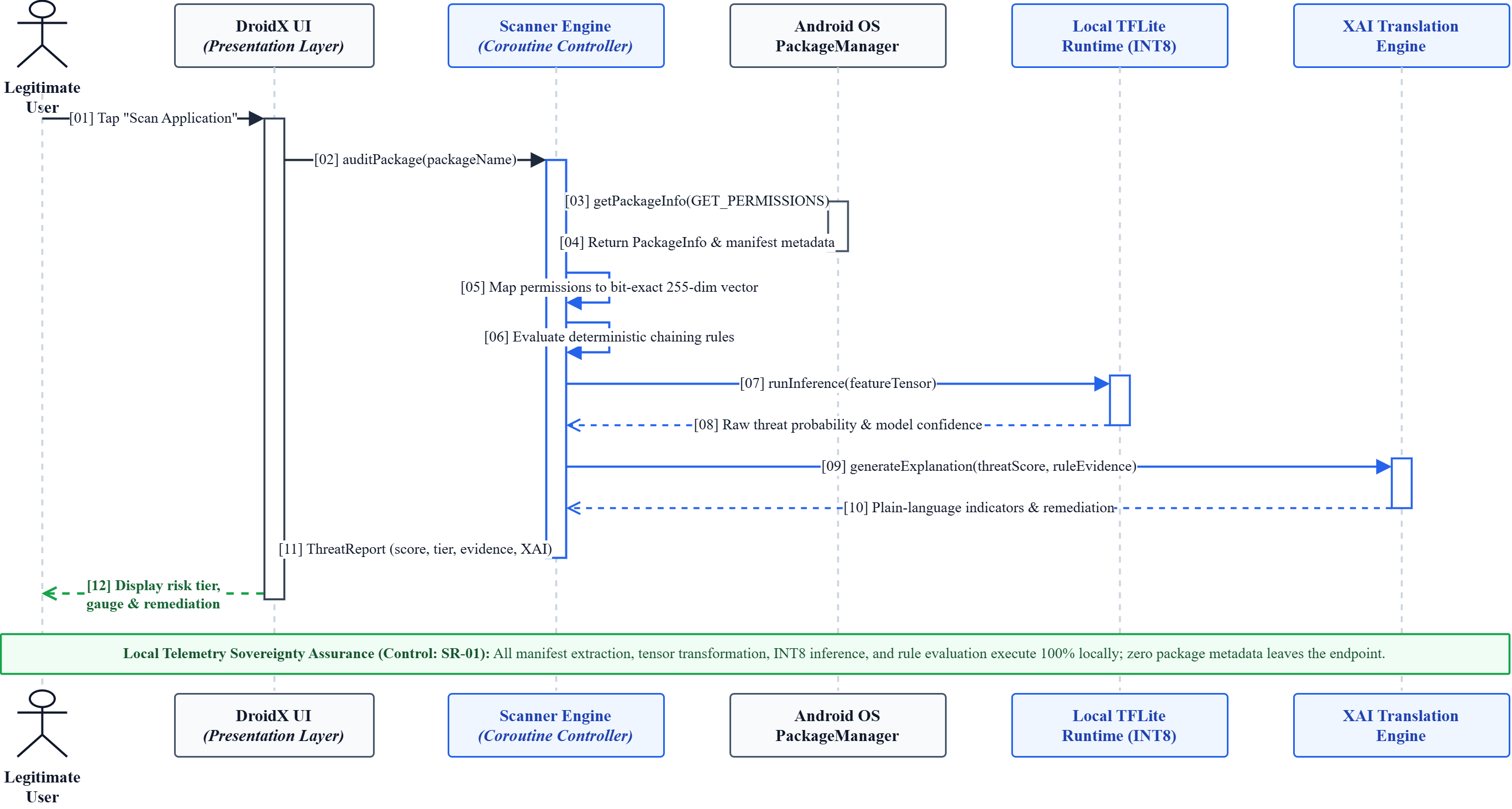
System Modeling & Execution Flow
Slide 16 / 19- Static Inference Flow: Asynchronous coroutine execution across TFLite & XAI.
- Integrity Check: Play Integrity API verifies bootloader/root states.
- Offline Fallback: Seamless fallback to local root heuristics when offline.
Live System Prototype (Demo)
Slide 17 / 19Thank You
Slide 18 / 19Thank You for Your Attention!
DroidX: Privacy-First, On-Device Mobile Cybersecurity
Committee Q&A
Slide 19 / 19Questions & Examination Session
We welcome feedback, questions, and architectural inquiries from the respected members of the Examination Committee.